🐠 Pencilfish
🧾 Quick Facts
Pencilfish are a charming group of small, elongated freshwater fish known for their peaceful nature and suitability for community aquariums. They are popular among aquarists for their intriguing behaviors and subtle beauty.
- Common names: Pencilfish, Dwarf Pencilfish, Beckford's Pencilfish
- Scientific name: Varies (Nannostomus genus)
- Freshwater / Marine / Brackish: Freshwater
- Origin: Amazon Basin, South America
- Typical adult size range: 1 to 2 inches (2.5 to 5 cm)
- Lifespan: 3 to 5 years
- Temperament: Peaceful
- Recommended tank size: Minimum 10 gallons (37 liters)
- Water temperature range: 73 to 81°F (23 to 27°C)
- pH / hardness: pH 6.0 to 7.0, soft to moderately hard water
- Diet type: Omnivore
- Activity zone: Mid to top
- Social needs: Schooling
- Beginner suitability: Easy
🔍 Identification
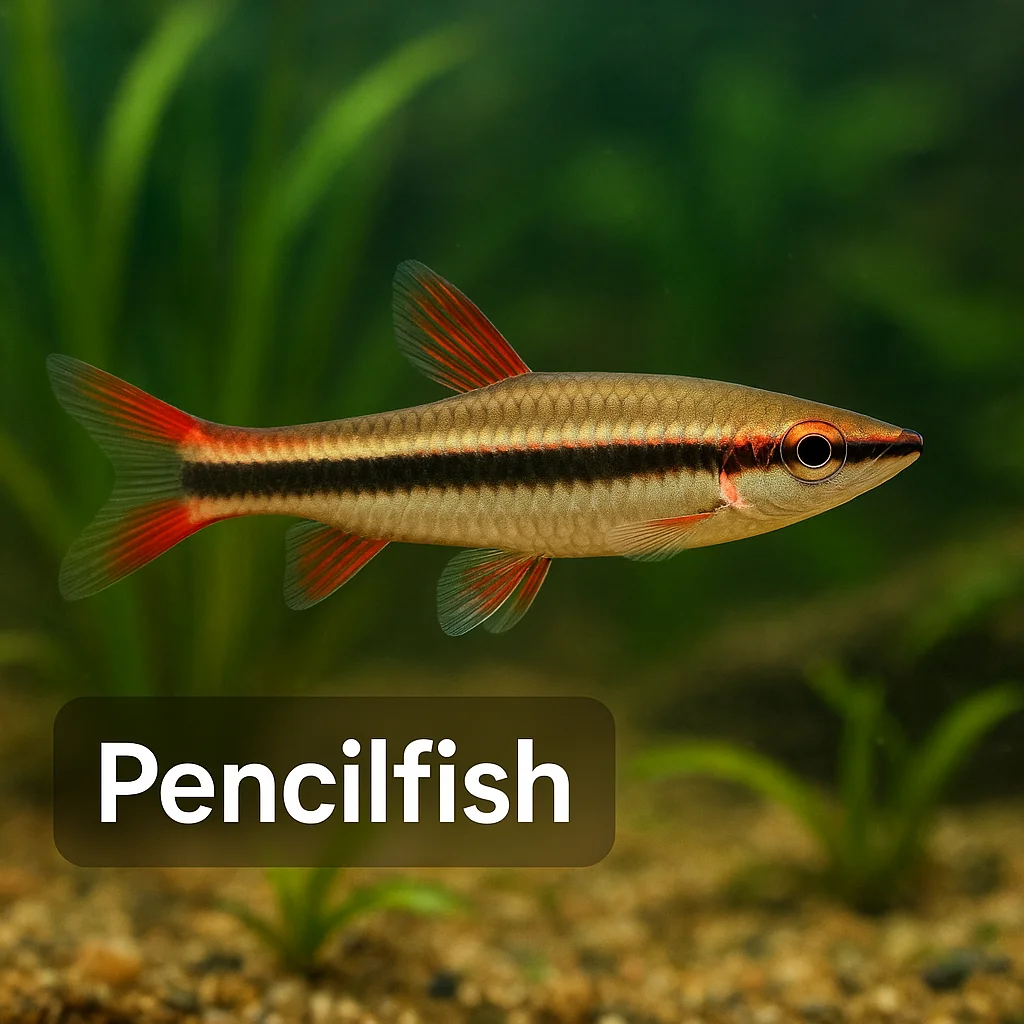
Pencilfish are easily recognizable by their slender, elongated bodies and horizontal stripes. They typically have vibrant colors that can vary between species, with hues of red, black, and gold being common. During different moods or breeding phases, their colors may deepen or change.
The fins of pencilfish are usually small and rounded. Males often display more intense coloration than females, which can help with sex differentiation. Common look-alikes include some species of tetras; however, pencilfish have a more slender and horizontally stretched body shape compared to the typical tetra.
- Slender, elongated body shape
- Horizontal stripes along the body
- Vibrant colors: red, black, gold
- Small, rounded fins
- Males often display more intense colors
- Peaceful demeanor
- Easily recognizable compared to similar species
🌍 Origin & Natural Habitat
Pencilfish are native to the slow-moving waters of the Amazon Basin in South America. They are typically found in floodplains, streams, and rivers that have a substrate of leaf litter and are rich in decaying plant material.
These environments are often shaded by canopy trees, providing a dimly lit habitat. The water tends to be soft, acidic, and stained with tannins. Understanding their natural habitat helps aquarists recreate suitable conditions in the aquarium, aiding both their health and display behavior.
🧪 Tank Setup & Water Parameters
Pencilfish thrive in well-planted tanks with ample swimming space. A minimum tank size of 10 gallons is recommended, with a length that facilitates the horizontal swimming typical of this species. A gentle filtration system is preferred to mimic their natural, slow-flowing habitats.
Include driftwood, leaves, and plenty of plants to provide both cover and the acidity these fish enjoy. Low to moderate lighting is ideal to replicate their natural environment.
- Minimum tank size: 10 gallons
- Ample horizontal swimming space
- Gentle filtration
- Include driftwood and plants
- Low to moderate lighting
- Soft, slightly acidic water
- Provide hiding spots with decor
🤝 Temperament & Compatibility
Pencilfish are highly sociable and should be kept in schools of at least six to eight individuals. They are peaceful and get along well with other small, non-aggressive fish. Suitable tankmates include small tetras, rasboras, and peaceful bottom dwellers like Corydoras.
While they are generally non-confrontational, they may display slight fin-nipping behavior towards long-finned species during feeding or when stressed.
- Keep in groups of six or more
- Compatible with small, peaceful fish
- Avoid aggressive or much larger tankmates
- May slightly nip at long fins
- Peaceful during feeding and breeding
- Provide ample swimming space to reduce stress
🍽️ Diet & Feeding
In the wild, pencilfish consume small invertebrates and plant matter. In captivity, they adapt well to flake, pellet, and freeze-dried foods. Supplementing their diet with live or frozen foods like brine shrimp and daphnia can enhance coloration and vitality.
Feed once or twice daily, offering only what they can consume in a few minutes to avoid water quality issues.
- Omnivorous diet; enjoys variety
- Flakes, pellets, freeze-dried foods
- Supplement with live/frozen options like brine shrimp
- Feed once or twice daily
- Avoid overfeeding
- Monitor feeding to ensure all fish eat
🧬 Growth, Color Changes & Lifespan
Pencilfish start with a more muted coloration in their juvenile stages, which develops into brighter hues as they mature. Adult coloration can intensify during breeding seasons or when males are establishing dominance.
Signs of stress in pencilfish include clamped fins, fading colors, and increased hiding. Optimal conditions with stable water parameters and a healthy diet can help maximize their lifespan, typically ranging between 3 to 5 years.
🪺 Breeding & Reproduction
Pencilfish are egg scatterers, and breeding typically occurs in the early morning. Providing slightly cooler, acidic water can trigger spawning behaviors. They do not engage in parental care, so it is essential to provide plenty of plant cover for the eggs and fry.
Raising fry successfully requires feeding them infusoria or other minute foods until they can consume larger particles.
Breeding in home aquariums is infrequent due to the specific conditions and care required.
🩺 Common Health Issues & Prevention
Common health issues for pencilfish include ich, fin rot, and parasitic infections. These can mostly be prevented with proper tank maintenance, stable water conditions, and a balanced diet.
- Quarantine new fish before introduction
- Maintain stable water parameters
- Avoid sudden temperature changes
- Do not overfeed
- Conduct regular water changes
- Monitor for signs of stress or illness
🌱 Role in the Aquarium
Pencilfish can be a delightful addition to community tanks, providing subtle coloration and active swimming behaviors that enhance tank dynamics. They are plant-safe and can help maintain balance by taking up a niche as mid-level swimmers.
They act as peaceful community players, encouraging calmer interactions among other tank inhabitants. Ensure they are acquired from reputable sources to avoid contributing to habitat destruction.
📉 Conservation & Responsible Keeping
While many pencilfish are now captive-bred, some may still be wild-caught. Captive-bred individuals generally adapt better to aquarium life and have less impact on natural populations. Never release aquarium fish into local waters, as this can harm ecosystems.
- Purchase from reputable sources
- Prefer captive-bred over wild-caught
- Never release into the wild
- Plan for possible rehoming needs
- Consider tank capacity and community dynamics for long-term success
📌 Summary
- Slender, elongated body with horizontal stripes
- Originates from the Amazon Basin, South America
- Thrives in well-planted, soft, and acidic water
- Peaceful temperament, suitable for community tanks
- Omnivorous diet; feed variety including flakes and live foods
- Beginner-friendly with a lifespan of 3 to 5 years
- Breeding is infrequent in home aquariums
- Captive-bred options preferred for sustainability