🐠 Clown Killifish
🧾 Quick Facts
The Clown Killifish, known for its captivating colors and small size, is a popular choice among aquarium hobbyists. Being a freshwater species, it appeals to both beginners and experienced aquarists who love its vibrant appearance and active nature.
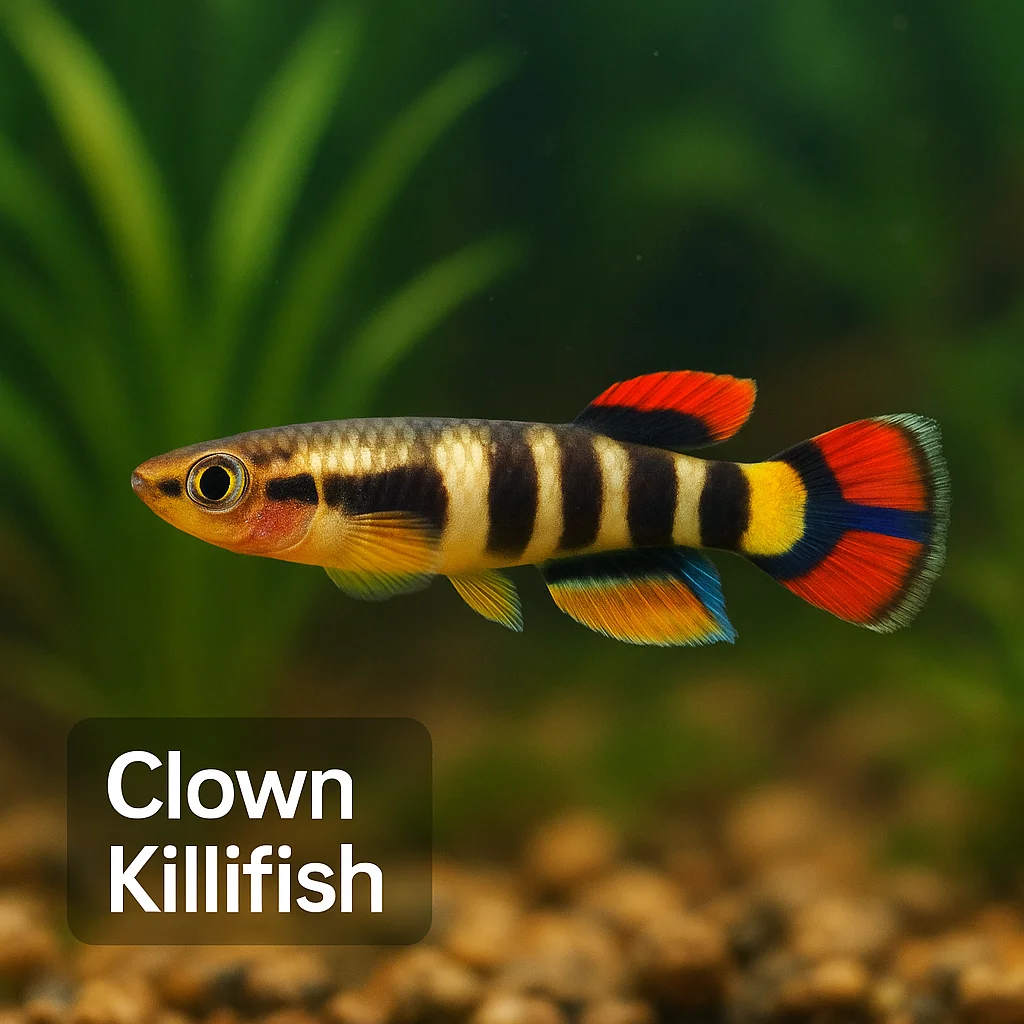
- Common names: Clown Killifish, Banded Panchax
- Scientific name: Epiplatys annulatus
- Freshwater
- Origin: West Africa (Liberia, Sierra Leone)
- Typical adult size range: 1.2 to 1.6 inches (3-4 cm)
- Lifespan: Varies, commonly 3-5 years
- Temperament: Peaceful
- Recommended tank size: Minimum 5 gallons
- Water temperature range: 70-80°F (21-27°C)
- pH range: 6.0-7.5
- Diet type: Omnivore
- Activity zone: Top
- Social needs: Pair or small group
- Beginner suitability: Easy
🔍 Identification
The Clown Killifish is easily recognized by its slender body adorned with striking bands of metallic blue and black, resembling a clown costume. Its dorsal and ventral fins are translucent with specks of red or orange, while its caudal fin displays a vivid coloration resembling a small flag. Males typically have more pronounced colors than females. Look-alikes include other species within the Epiplatys genus, but the Clown Killifish's unique banding pattern sets it apart.
- Slender, elongated body
- Metallic blue and black bands
- Flag-like caudal fin with red or orange
- Males are more colorful than females
- Translucent dorsal and ventral fins
- Active swimmers, often at the top
🌍 Origin & Natural Habitat
Clown Killifish are native to the slow-moving waters of West Africa, particularly in Liberia and Sierra Leone. They thrive in shallow, densely vegetated streams and small ponds, where the water is soft and slightly acidic. These environments often have leaf litter and submerged vegetation, providing ample hiding spots and breeding grounds. Understanding their natural habitat helps recreate a conducive environment in home aquariums, ensuring healthy behavior and vivid coloration.
🧪 Tank Setup & Water Parameters
While a 5-gallon tank can suffice for a small group of Clown Killifish, ensuring a horizontally oriented setup provides them with ample swimming space. A gentle filtration system is preferable, as strong currents can stress these small fish. Maintaining stable water temperatures is crucial, especially if the tank is situated in a fluctuating environment. Substrate can range from sand to fine gravel, with decorations such as driftwood and live plants offering additional cover and mimicking their natural habitat. Gentle lighting encourages natural behavior, and floating plants can provide shaded areas.
- Minimum tank size: 5 gallons
- Horizontal swimming space is essential
- Gentle filtration is preferred
- Stable water temperatures between 70-80°F
- Substrate: sand or fine gravel
- Includes decorations like driftwood and live plants
- Lighting should be gentle
- Provide floating plants for shade
🤝 Temperament & Compatibility
Clown Killifish are peaceful and thrive in community tanks with similarly sized non-aggressive species. Their social nature means they do best in pairs or small groups, where they can exhibit natural behaviors. They may display minor territorial behavior during feeding or breeding, but this rarely results in aggression. Ideal tank mates include small tetras, rasboras, and shrimp. Avoid housing them with larger or aggressive species, which might stress or prey on these diminutive fish.
- Peaceful nature
- Best kept in pairs or small groups
- Suitably matched with small tetras or rasboras
- Avoid larger, aggressive species
- Minor territoriality during feeding and breeding
- Individual behavior can vary
🍽️ Diet & Feeding
In the wild, Clown Killifish consume a variety of insects and larvae. In aquariums, they adapt well to a diet consisting of high-quality flakes, micropellets, and occasional live or frozen treats such as daphnia and brine shrimp. These fish are surface feeders, so ensuring food remains at the water's surface will help them readily accept it. Feeding small amounts multiple times a day prevents overfeeding and maintains water quality.
- Surface feeders; target floating foods
- Adaptable to high-quality flakes and micropellets
- Offer live or frozen options like daphnia and brine shrimp
- Feed small amounts multiple times daily
- Avoid overfeeding to maintain water quality
🧬 Growth, Color Changes & Lifespan
Juvenile Clown Killifish tend to have less vivid coloration, growing more striking as they mature, particularly males. Seasonal or mood-based changes may include intensified coloring during breeding or when establishing dominance. Signs of stress include clamped fins and dull coloration, often indicating a need to assess environmental conditions. Their lifespan typically ranges from 3 to 5 years, strongly influenced by diet, space, and water quality.
🪺 Breeding & Reproduction
Clown Killifish are egg layers, typically spawning in small clusters among dense vegetation. They display a subtle courtship where males enhance their colors and flutter around females. Eggs hatch within a week, with parents providing no care, making it essential to remove adults or provide plenty of cover to protect fry. Fry can be fed infusoria or finely crushed flakes until they are large enough for small live foods.
🩺 Common Health Issues & Prevention
Common health concerns for Clown Killifish include ich, fin rot, and external parasites. Preventive measures such as maintaining stable water parameters, regular tank cleaning, and quarantining new additions help mitigate these risks. Stress from poor conditions can lower their immunity, making them more susceptible to diseases.
- Stable water parameters are crucial
- Regular cleaning and maintenance
- Quarantine new fish before introducing them
- Avoid sudden changes in environment
- Observe for signs of stress or illness regularly
🌱 Role in the Aquarium
As active, colorful swimmers, Clown Killifish add vibrant movement to the top layer of an aquarium. Their peaceful nature complements small community setups, offering a pleasant contrast to more subdued fish. Ensuring their captivity comes from ethical sources supports ecosystem conservation and reduces the demand for wild capture.
📉 Conservation & Responsible Keeping
Opting for captive-bred Clown Killifish supports sustainable practices that protect wild populations. Never release aquarium fish into local waters, as they can disrupt ecosystems. If a fish outgrows its current setup, consider rehoming options through local clubs or responsible pet stores.
- Choose captive-bred over wild-caught
- Never release into local environments
- Consider rehoming if tank size becomes insufficient
- Ensure ethical sourcing and buying practices
- Support conservation efforts indirectly
📌 Summary
- Distinctive metallic blue and black bands for ID
- Originates from West African vegetated waters
- Prefers a gently filtered tank with a calm environment
- Compatible with small, peaceful community fish
- Feeds on a variety of floating foods
- Slightly more colorful males than females
- Breeds in densely planted areas without parental care
- Average lifespan of 3-5 years under good conditions
- Emphasizes conservation by choosing captive-bred
- Easy maintenance and suitable for beginners