🐠 Cardinal Tetra
🧾 Quick Facts
The Cardinal Tetra, known for its vivid coloration and peaceful nature, is a staple in freshwater aquarium hobby. This small but striking fish forms tight schools and brings vibrant movement to planted tanks.
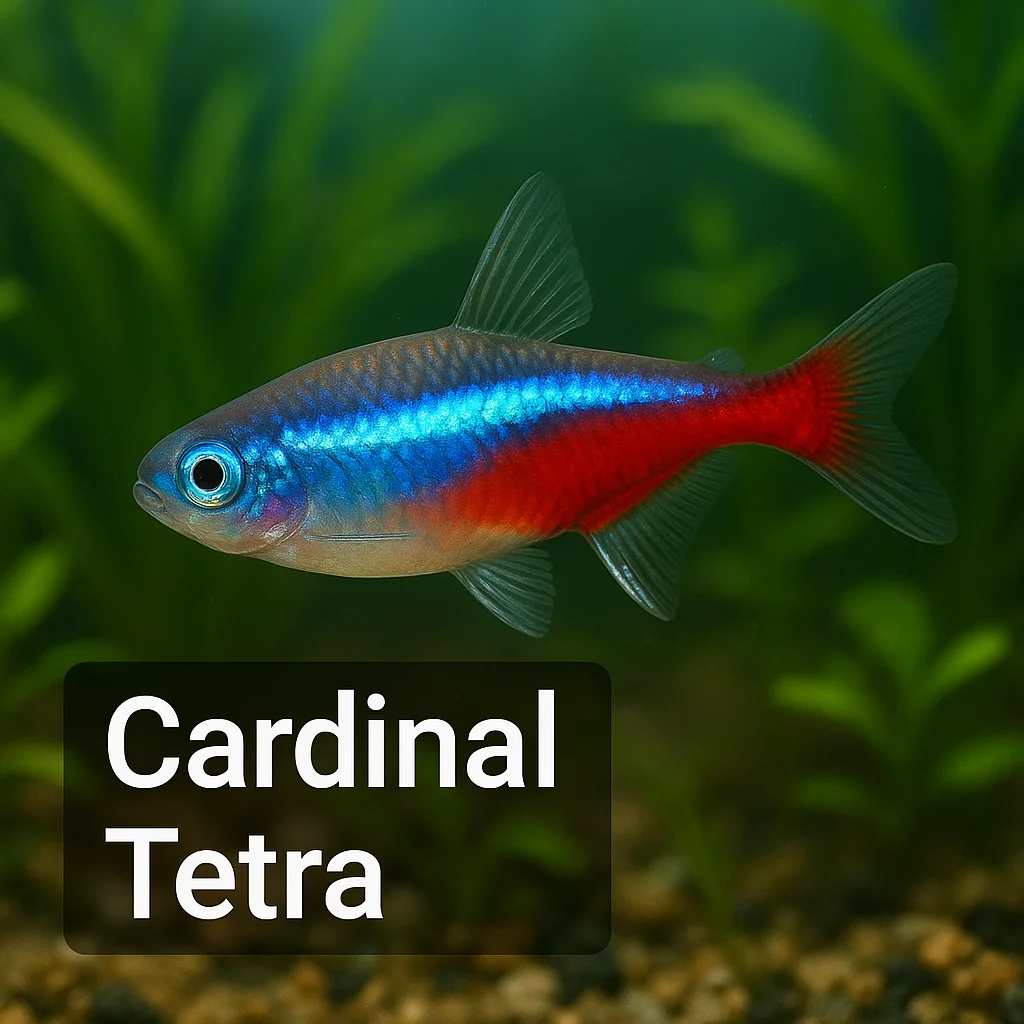
- Common names: Cardinal Tetra
- Scientific name: Paracheirodon axelrodi
- Freshwater / Marine / Brackish: Freshwater
- Origin: Amazon River basin (Brazil, Colombia, Venezuela)
- Typical adult size range: 2-2.5 cm (0.8-1 inch)
- Lifespan: 4-5 years (varies with care)
- Temperament: Peaceful
- Recommended tank size: Minimum 20 gallons
- Water temperature range: 23-27°C (73-81°F)
- pH / hardness: pH 5.5-7; soft water preferred
- Diet type: Omnivore
- Activity zone: Mid-top dwellers
- Social needs: Schooling
- Beginner suitability: Easy
🔍 Identification
The Cardinal Tetra is easily recognized by its vibrant stripe of red running along its lower half, from snout to tail, contrasting with an iridescent blue stripe above. Its fusiform body is sleek, aiding in swift schooling movements.
Males and females appear similar, although females may be slightly rounder. The closest look-alike, the Neon Tetra, has a smaller red patch that only reaches midway along the body.
- Look for a vivid red stripe along the full body length.
- Notice the iridescent blue line above the red stripe.
- Check the sleek, torpedo-shaped body.
- Observe school movement; they prefer staying in groups.
- Compare with Neon Tetras; Cardinals have longer red stripes.
- Mood changes may subtly affect stripe brightness.
- Females are slightly plumper than males.
- Whole fish visible in a balanced, colorful display tank.
🌍 Origin & Natural Habitat
Originating from the lush Amazon jungle, Cardinal Tetras thrive in slow-moving tributaries, backwaters, and floodplains. They prefer environments with dense vegetation, cover from fallen leaves, and subdued lighting from overhanging canopies, which closely mimic the conditions of a densely planted aquarium.
Understanding their natural habitat helps recreate suitable tank environments, ensuring their health and vibrant coloration.
🧪 Tank Setup & Water Parameters
The ideal tank setup for Cardinal Tetras closely mimics their natural habitat: soft, acidic water and plentiful swimming space. A spacious, planted tank with ample cover options recreates the safety of their wild environment.
A planted substrate with driftwood and leaf litter can make them feel at home, as will subdued lighting. Stable temperatures without drastic fluctuations are preferred.
- Setup Checklist:
- Tank size: minimum 20 gallons for a school.
- Provide efficient filtration; gentle current preferred.
- Maintain temperatures between 23-27°C (73-81°F).
- Soft substrate encourages natural browsing behavior.
- Include live plants and driftwood for cover and exploration.
- Subdued lighting mimics natural habitat.
- Regular water changes to maintain water quality.
🤝 Temperament & Compatibility
Cardinal Tetras are peaceful schooling fish that thrive best in groups of six or more. They exhibit synchronized swimming and form tight-knit schools, which is a protective mechanism in the wild.
They get along well with other peaceful species like small rasboras, corydoras catfish, and non-nippy, small barbs, but should not be mixed with larger, aggressive fish that may see them as prey.
- Compatibility Notes:
- Compatible with other small peaceful fish.
- Avoid housing with aggressive or large fish.
- Better in groups of six or more.
- Peaceful behavior evident during feeding and exploring.
- Individual behavior may vary with tank conditions.
🍽️ Diet & Feeding
In the wild, Cardinal Tetras feed on small invertebrates, plant matter, and detritus. In an aquarium setting, they are not picky eaters and thrive on a varied diet.
A balanced diet consisting of high-quality flakes, micro-pellets, live foods like daphnia and brine shrimp, and occasional vegetable matter keeps them healthy and their coloration vivid.
- Feeding Tips:
- Offer high-quality flakes and micro-pellets as staple foods.
- Supplement with live or frozen foods like daphnia.
- Feed small portions twice daily to prevent overfeeding.
- Varied diet helps maintain vibrant coloration.
- Observe for any refusal of certain foods; adjust accordingly.
🧬 Growth, Color Changes & Lifespan
Cardinal Tetras do not have drastic juvenile to adult transformations but may show more intense coloration as they mature. Stress indicators include clamped fins, dull colors, and hiding. Ensuring a stable environment prolongs their lifespan of 4-5 years.
🪺 Breeding & Reproduction
Cardinal Tetras are egg layers, preferring slightly acidic waters for spawning, similar to their natural habitats. Inducing breeding may require controlled conditions such as soft water, dim lighting, and increased temperature.
While they do not exhibit parental care, their eggs are prone to predation, thus requiring isolation in breeding tanks. Feeding young fry with infusoria or specialized fry foods is recommended.
🩺 Common Health Issues & Prevention
Cardinal Tetras can be susceptible to common freshwater diseases such as ich and fin rot. Preventing disease involves maintaining stable water conditions, a balanced diet, and practicing good tank hygiene.
- Prevention Basics:
- Regular water changes prevent waste buildup.
- Quarantine new fish to limit disease risk.
- Avoid sudden changes in water parameters.
- Do not overfeed, which can degrade water quality.
- Ensure efficient filtration for clean water.
🌱 Role in the Aquarium
Cardinal Tetras serve as vibrant community members, adding color and dynamism to any peaceful tank. Their schooling nature offers mesmerizing displays of synchronized swimming cohesiveness.
Obtaining them from reputable breeders supports ethical keeping practices, minimizing the impact on wild populations while ensuring healthier, more adaptable fish.
📉 Conservation & Responsible Keeping
While not currently endangered, responsible keeping involves preferring captive-bred individuals over wild-caught ones, reducing ecological strain on natural populations.
If a Cardinal outgrows its tank, rehoming via local aquarium clubs or communities is a responsible measure, never releasing them into local waters due to the potential introduction of invasive species.
- Responsible Keeping Tips:
- Opt for captive-bred Cardinals when possible.
- Never release aquarium fish into the wild.
- Consider rehoming through aquarium communities if necessary.
- Maintain proper tank conditions to ensure longevity.
- Educate fellow hobbyists about responsible aquarium management.
📌 Summary
- Identified by vibrant red and blue stripes.
- Originates from the Amazon River basin.
- Prefers well-planted tanks with soft, acidic water.
- Peaceful and compatible with other small community fish.
- Diets include flakes, pellets, and live foods.
- Easy to care for, making it suitable for beginners.
- Breeding in captivity requires specific conditions.
- Maintaining water quality is crucial for health.
- Contributes color and movement to community tanks.
- Choose captive-bred to preserve wild populations.