🐠 White Cloud Mountain Minnow
🧾 Quick Facts
The White Cloud Mountain Minnow is a small, peaceful freshwater fish popular in aquariums for its striking appearance and easy care. Known for its adaptability, this species is a great choice for both beginners and experienced aquarists.
- Common names: White Cloud Mountain Minnow, Chinese Danio
- Scientific name: Tanichthys albonubes
- Freshwater / Marine / Brackish: Freshwater
- Origin: China, specifically the White Cloud Mountain region
- Typical adult size range: 1 to 1.5 inches (2.5 to 4 cm)
- Lifespan: 3 to 5 years
- Temperament: Peaceful
- Recommended tank size: 10 gallons (38 liters) minimum
- Water temperature range: 64 to 72°F (18 to 22°C)
- pH / hardness: pH 6.0 to 8.0, slightly soft to moderately hard water
- Diet type: Omnivore
- Activity zone: Top to mid-level
- Social needs: Schooling fish
- Beginner suitability: Easy
🔍 Identification
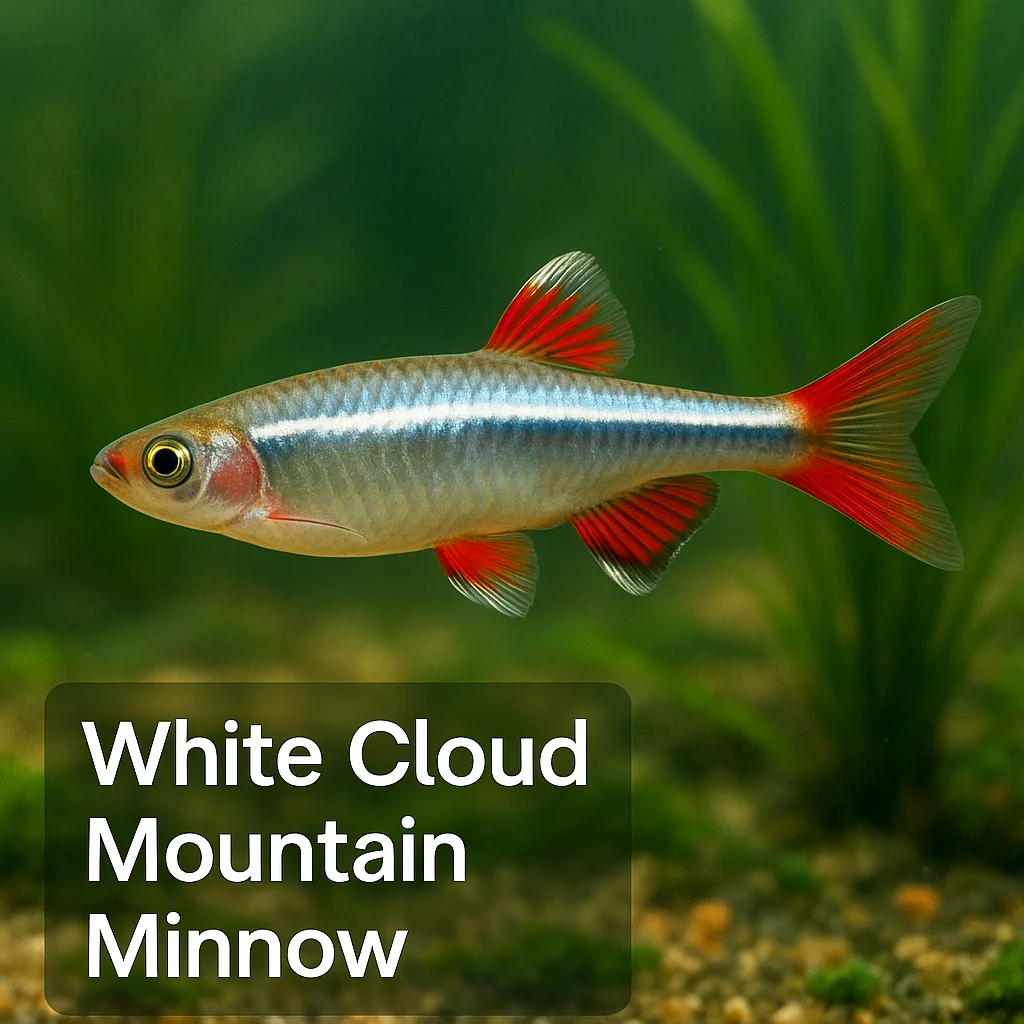
The White Cloud Mountain Minnow is easily identified by its slender, streamlined body and colorful, iridescent scales. Typically, its body displays hues of silver or golden-brown with a distinct lateral stripe of metallic blue, and red-tipped fins that intensify during social displays or breeding periods. The dorsal fin is upright and narrow, contributing to its sleek profile. Males can be distinguished from females by their slightly slimmer bodies and more vibrant coloring, especially during breeding seasons. This fish may be confused with Neon Tetras or Cardinal Tetras, but it lacks the intense neon blue stripes of these species.
- Slender, elongated body shape
- Metallic blue lateral stripe
- Red-tipped fins
- Males are slimmer with brighter colors
- Lacks neon blue stripes of similar tetras
- Whole fish visible with iridescent scales
- Best identified by size and peaceful demeanor
🌍 Origin & Natural Habitat
Originating from the White Cloud Mountain region of Guangdong, China, these minnows inhabit cooler, slow-flowing mountain streams. Their native waters are typically plant-rich, promoting ample cover and food sources. Such environments experience seasonal variations in temperature, but they generally remain within the mild to cool range due to elevation. Understanding their natural habitat helps aquarists mimic conditions that support health and vibrancy, like maintaining cooler water temperatures and providing plant coverage.
🧪 Tank Setup & Water Parameters
A suitable habitat for White Cloud Mountain Minnows starts with a tank capacity of at least 10 gallons, offering ample horizontal space for swimming. A moderate filtration system simulates natural slow water flow while keeping the environment clean. A heater might not be necessary given their tolerance for cooler water, though stable temperatures are important. Plant decorations like java moss and Anubias can provide shelter, while a dark substrate highlights their colors. Moderate lighting is preferable to mimic natural conditions and enhance their appearance.
- 10-gallon minimum tank size
- Moderate flow filtration system
- Cool water environment, stable temperature
- Plant decorations for cover
- Dark substrate to showcase colors
- Moderate lighting conditions
- Ample horizontal swim space
🤝 Temperament & Compatibility
White Cloud Mountain Minnows are known for their peaceful nature and tendency to school, making them an excellent addition to community tanks. They thrive in groups of six or more, where social interactions spur natural behaviors and vivid coloration. Compatible tankmates include other peaceful fish such as small tetras, rasboras, and similar temperate species. Larger or aggressive fish should be avoided, as well as species that require vastly different water parameters. Though generally adaptable, individual behaviors can vary slightly; observation is key to maintaining harmony.
- Schooling fish in groups of six or more
- Peaceful demeanor; ideal for community tanks
- Compatible with small tetras and rasboras
- Avoid housing with large/aggressive species
- Monitor interactions for potential incompatibilities
- Behavior may vary between individuals
🍽️ Diet & Feeding
As omnivores, White Cloud Mountain Minnows consume a varied diet in their natural habitat, primarily consisting of small insects, larvae, and plant material. In captivity, they readily accept a mix of flake and pellet foods designed for smaller fish, complemented by regular offerings of live or frozen foods like bloodworms and brine shrimp. Feeding should be carried out twice daily, providing only as much food as they can consume in a few minutes to prevent overfeeding. They are not considered picky eaters, making them easy to feed.
- Omnivore with a varied diet
- Accepts flakes, pellets, live, and frozen foods
- Feed twice a day; small portions
- Supplement with bloodworms and brine shrimp
- Easy to feed, not picky
🧬 Growth, Color Changes & Lifespan
White Cloud Mountain Minnows undergo subtle changes from juveniles to adults, including intensified coloration and slight size increase. The reflective stripe and red fins become more vivid with maturity, and during breeding seasons, the colors of males intensify further. Stress may cause temporary color fading and subtle behavioral changes such as hiding or clamped fins. Typically, these minnows live for 3 to 5 years, with proper space, diet, and water quality being critical for maximizing their lifespan.
🪺 Breeding & Reproduction
These minnows are egg layers, often spawning when water temperatures slightly increase, mimicking the onset of spring. Males exhibit vibrant colors and court females with subtle displays. Once fertilized, eggs are scattered among plants and left unattended. Fry emerge in a few days and can be fed infusoria or commercial fry foods. While breeding in home aquariums is not uncommon, it can be enhanced by providing optimal conditions and a dedicated breeding tank.
🩺 Common Health Issues & Prevention
White Cloud Mountain Minnows are fairly hardy but can experience issues common to freshwater fish, such as ich (white spot disease), fin rot, and internal parasites. Prevention through strict quarantine procedures for new additions, stable water conditions, and avoiding overfeeding is essential. Mitigating stress by ensuring compatible tankmates and a quality diet helps ward off health problems.
- Quarantine new specimens
- Maintain stable water conditions
- Prevent overfeeding
- Provide a stress-minimized environment
- Regular tank maintenance and checks
🌱 Role in the Aquarium
White Cloud Mountain Minnows add serenity and vibrant color to community aquariums. Their dappled movements capture observer interest, promoting a dynamic yet peaceful tank environment. They cohabit well with live plants, making them ideal companions in planted aquariums. Ethically, it's crucial to purchase minnows from responsible breeders to avoid issues associated with wild catches.
📉 Conservation & Responsible Keeping
Wild populations of White Cloud Mountain Minnows are under pressure, making captive-bred specimens a preferable choice. Captive breeding not only supports conservation efforts but also ensures better adaptation to home aquariums. Aquarists should never release them into local waters, as they can disrupt ecosystems. Rehoming options exist if tank conditions change, ensuring a continuous ethical responsibility.
- Opt for captive-bred over wild-caught
- Do not release into non-native waters
- Ensure ethical acquisition from breeders
- Consider rehoming if tank becomes unsuitable
- Support global conservation initiatives
📌 Summary
- Recognizable by metallic lateral stripe and red fins
- Native to China's cool mountain streams
- Minimum 10-gallon tank recommended
- Best in groups, compatible with peaceful fish
- Omnivorous diet; accepts varied foods
- Easy care level, suitable for beginners
- Prone to stress-induced color fading
- Breeding possible in home aquariums
- Captive-bred preferred for ecological balance